1,2. Немецкий унтерофицер 158-го пехотного полка. Манчестер Хилл, 21 марта 1918 года.
Weapons, dress and equipment
Easy to point and quick to discharge, the ‘Luger’ pistol (1) offered fair stopping power, but could be temperamental under muddy conditions. He carries a Stielhandgranate (2), a key infantry weapon widely issued from 1915.
His steel helmet (3) is camouflaged in a sacking cover. He wears the 1915-type fly-fronted Bluse (4); the shoulder straps (5) display the regimental numerals and the green collar (6) has an edging of silver-coloured lace, the rank insignia of the Unteroffizier. He also wears corduroy trousers (7) with leather knee-patches, puttees (8) and black ankle boots (9).
The pistol holster (10) on his waist belt is worn alongside wire cutters (11). A bread bag (12) with a water bottle attached (13) are carried at his rear right. His gas mask (14) is carried in the ready position, while its cylinder (15) is suspended under his left arm by a narrow strap. Carried on shoulder straps concealed by the grenade bags (16) worn under both arms, his Sturmgepäck (assault equipment) consists of a mess tin (17) around which is wrapped a rolled shelter-quarter (18) secured with straps.
3,4. Британский второй лейтенант 16-го Манчестерского полка. Манчестер Хилл, 21 марта 1918 года.
Weapons, dress and equipment
This officer’s main weapon is a .303in SMLE Mk III rifle (1) with Pattern 1907 bayonet (2) affixed. He also carries a .455in Webley Mk VI revolver (3), attached to a lanyard around his neck and holstered on his left side so as to be drawn across with the right hand.
He wears a steel helmet (4). Intended to make the officer wearing it indistinguishable from ‘other ranks’ at a distance his ‘wind up’ jacket (5) is an issue khaki service dress (SD) garment bearing just a single ‘pip’ on each shoulder, regimental ‘collar dogs’ and 30th Division upper-arm insignia (6). The jacket is worn with SD trousers (7), puttees (8) and ankle boots (9). His personal equipment includes a leather waist belt (10) and small pistol-ammunition pouch (11), plus a rifle-ammunition bandolier (12) over his left shoulder. He also carries a carrotshaped ‘private purchase’ flask (13), examples of which appear in various regimental museum collections.
5,6. Райфл Вуд, 1 апреля 1918 года.
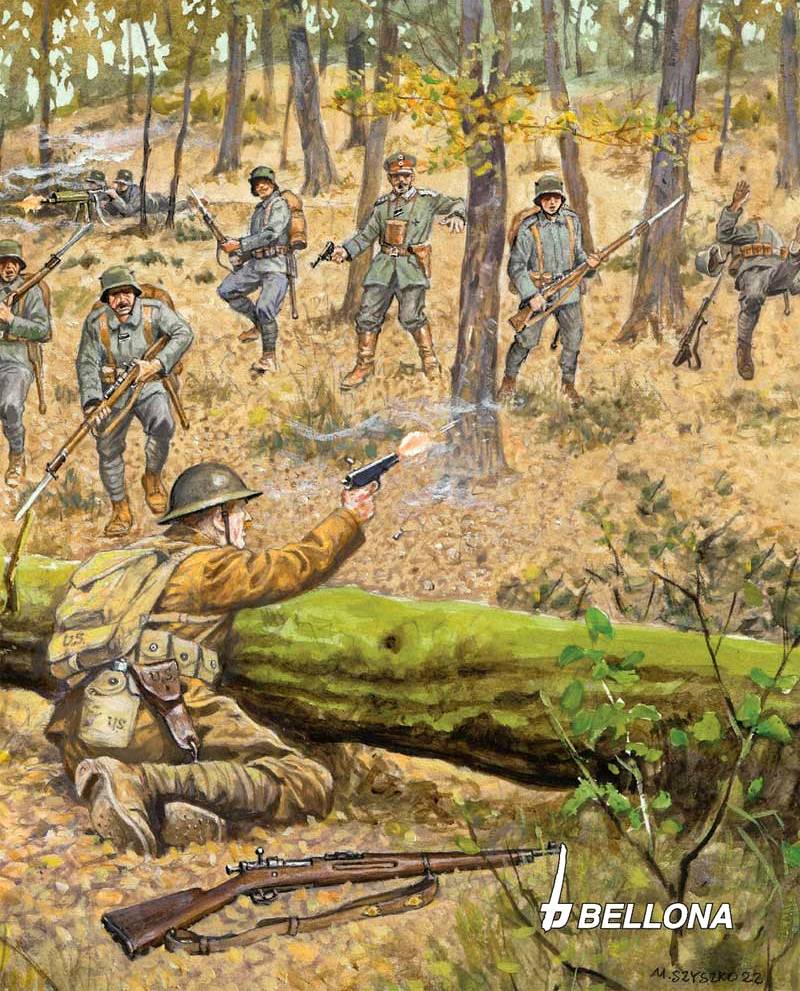
British view: This is the view of a soldier of the 20th Hussars at about 0920hrs, as the dismounted cavalry formations come into view of the German defenders of Rifle Wood and nearby trenches. While our soldier can see the backs of men in the section ahead of him wearing cavalry equipment and attempting to engage enemy troops whose heads can fleetingly be seen bobbing up and down in Heidelberg Trench, the rest of the scene is almost an ‘empty battlefield’. German machine-gun fire has commenced from the flank and a few rifle shots from the front are inflicting casualties, and a few artillery shells burst at the edge of the wood. Yet this was an early crisis of the action, as the British cannot see where the bulk of the enemy are, and with the three 20th Hussars platoon commanders wounded, Captain Hall has to take charge and urge on the men before their morale is shaken.
German view: This is the battlefield as seen by a member of a German picquet on the edge of Rifle Wood. The British, in the nearest line, have suddenly come into view having emerged from the valley of the Luce stream and crossed a lane, with the Canadian dismounted cavalry, also in an extended line of platoons, coming on behind them. Captain Hall of the 20th Hussars is a tiny figure, just identifiable with the central platoon of his troops, pistol raised above his head. Our observer can see a comrade in the foreground and both men have just opened fire with their Gew 98 rifles, but other than this the German defence is limited, including only one MG 08/15 light-machine-gun team and a handful of riflemen concealed in Heidelberg Trench, visible slightly downslope to the right. Putting only the minimum number of troops in the ‘shop window’ was good tactical practice, and casualties have been inflicted, but the few Germans here will not be enough to hold back the British and Canadians, who will soon be storming the edge of the wood.
7. Захват пулемётного гнезда.
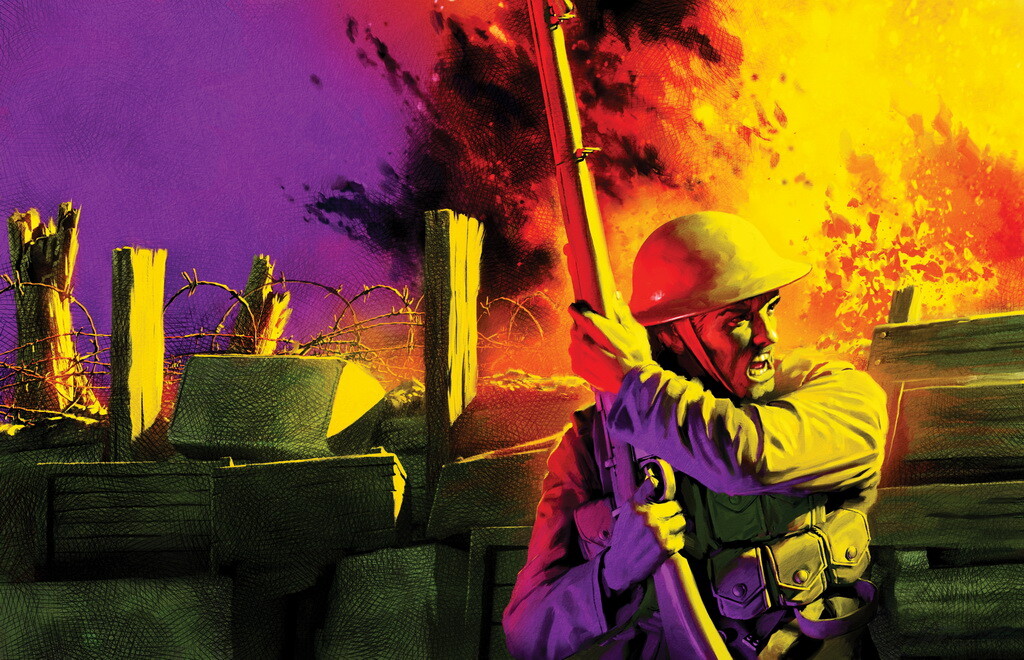
According to a plan hatched by Major Harold W. Dick two small detachments were allotted to take a German machine-gun post occupying a shell hole just forward and to the right of 5th East Lancashire’s front line, after daylight at about 0715hrs on 20 October 1918. While six other ranks with Second Lieutenant Harry Holdsworth circled stealthily around the back of the Germans, three more, with the major himself, approached frontally once the enemy troops were engaged from the rear. Our view is that of a private soldier in the major’s little group at the denouement of the action. From here we can see Major Dick advancing with his .455in Enfield revolver drawn, a fallen German of IR 116 at his feet. The major is in service dress with the white-over-red sign of 42nd (East Lancashire) Division on his upper arm, the only other insignia visible from this angle being the small crown rank badge on his shoulder strap. Like some of the other British troops he still has on his improvised white armband, intended to identify friendly troops during the night. The seven khaki-clad figures advancing towards us from the background are Second Lieutenant Holdsworth (third from left) and his six men. Most carry rifle with fixed bayonet, including Holdsworth. One man, in the middle of the group next to Holdsworth, is a ‘bomber’. We can see his web ‘grenade waistcoat’, and arm raised ready to throw should the remaining Germans not surrender. The whole team are in ‘battle order’ with small packs on their backs and the small box respirator (SBR) bag on the chest, except the bomber who must contrive to keep his grenades accessible and gas-mask case to one side.
The grey-clad Germans occupy the centre ground, and four of them appear unwounded and likely to be captured together with at least two MG 08/15 light machine guns. Several men have steel helmets with the ‘lozenge’-pattern camouflage of green, ochre and reddish-brown outlined in black, as authorized from the summer of 1918. The fallen German in the foreground, hit before he could activate a stick grenade, has shed his headgear to reveal the lining of three fabric pads in leather pockets. Two of the helmeted Germans in the shell hole wear the Sappenpanzer trench armour, mainly used by sentries or machine-gunners. Two men (to the left) have grey other ranks’ field caps.

 t1aro
t1aro alZarif
 Haktar
 Mady
Mady Corrector
 kosak4
 Dr.Schmeisser
 KhanBagatur
 gurvinek2005
 Crusader556
 Valyrian_Legionnaire
 DinarMayor
 Farin Frostgeir